


Why Your Digestive System Isn’t Responding (And What Most People Miss)
- Andy Audet
- Apr 22
- 3 min read
Bloating.
Constipation.
Reflux.
IBS.
SIBO.
Colitis.
You try to fix it.
You change your diet.
You remove foods.
You add supplements.
You support your microbiome.
Sometimes it helps.
But often…
👉 it doesn’t last
👉 or it only partially improves
So you keep adjusting the chemistry.
More enzymes.
More probiotics.
More protocols.
But here’s what most people don’t consider:
👉 your digestive system doesn’t run on chemistry alone.
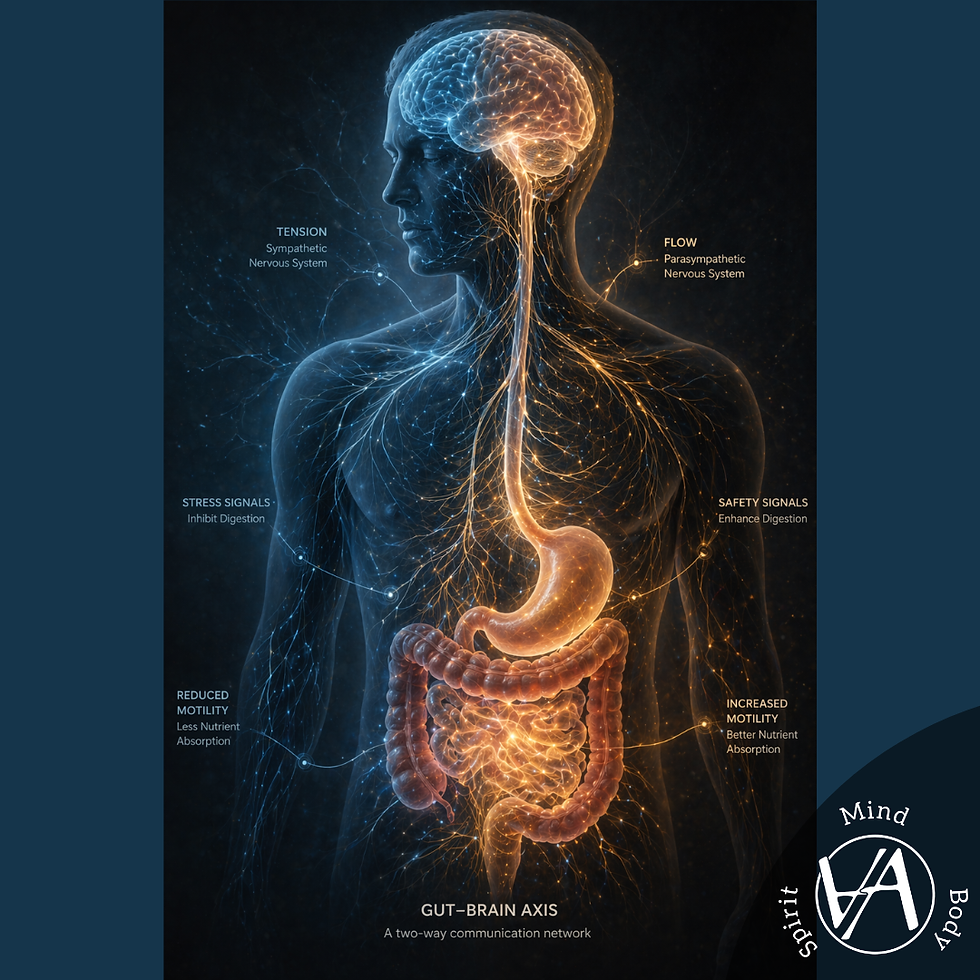
👉 it runs on signals (Mayer, 2011; Carabotti et al., 2015).
The digestive system is highly influenced by the state of the nervous system (Mayer, 2011; Rhee et al., 2009).
Your gut is constantly receiving instructions from your nervous system.
When to digest.
How much to produce.
How fast to move.
What to absorb.
What to eliminate.
👉 Autonomic and neural regulation influence digestive function, motility, and sensitivity (Konturek et al., 2011; Qin et al., 2014).
And those instructions change depending on your internal state.
👉 When the system is in a constant stress or overload state, digestion is not prioritized – it is downregulated (Konturek et al., 2011; Taché & Bonaz, 2007).
If your system is in stress…
Digestion slows down.
Blood flow shifts away.
Secretion changes.
Motility changes.
👉 Because your body is prioritizing survival.
You can eat the best foods.
Take the right supplements.
But if the signal stays the same…
👉 the response will stay the same.
👉 Digestion doesn’t only depend on what you eat —it depends on the state of the system processing it (Carabotti et al., 2015; Cryan & Dinan, 2012).
That’s why many people feel like they’re:
“doing everything right”…but still dealing with symptoms.
This doesn’t mean the biochemical approach is wrong.
It means it’s incomplete.
👉 Even with optimal nutrition, regulation plays a key role in how the body processes it (Rhee et al., 2009; Mayer, 2011).
Because if the signaling is off…
You’re trying to fix chemistryon top of a system that isn’t regulating properly.
And that’s where things change.
I’ve worked with people who had digestive issues for years (see video here).
Even professionals in the field (see video here).
People who understood nutrition deeply…
but were still stuck in the same patterns.
And when the system reorganizes…
👉 digestion changes
👉 symptoms drop
👉 responses become more consistent
Sometimes quickly.
Not because we forced anything.
👉 But because the system had access to a different way of organizing itself.
👉 Regulation plays a key role in how digestive function is expressed (Bonaz et al., 2018; Qin et al., 2014).
For more complex conditions like:
Colitis
IBS
SIBO
There’s often a need for multiple layers of support.
Nutrition matters.
Environment matters.
But regulation still matters.
Because digestion requires a certain state to function properly.
And many people are operating from a system that is:
👉 overactivated
👉 overloaded
👉 constantly compensating
So the question becomes:
Not just “what should I take?”
But:
👉 “what state is my system operating from?”
Because that changes everything.
At a deeper level…
We don’t just digest food.
We digest experience.
And when the system isn’t processing well…
It shows up in different ways.
This is where my work comes in.
I don’t work by adding more to manage symptoms.
I work on how your system organizes itself—
so the signal changes at the source.
And when that changes…
The body responds differently.
Not through force.
👉 Through access.
If you feel like you’ve tried everything…
but something is still missing—
you’re probably not wrong.
You may just be working at the wrong level.
If There’s One Thing To Take From This:
At some point, it’s not about adding more.
👉 You’re trying to fix chemistry on top of a system that isn’t regulating properly.
And no amount of supplements fixes that.
👉 Because what’s missing isn’t something to take—
it’s a signal your system can finally work with.
Andy Audet – Un Corps Équilibré
Specialist in Body Recalibration and Human Performance
Saint-Bruno-De-Montarville, Québec
References
Mayer, E. A. (2011). Gut feelings: the emerging biology of gut–brain communication. Nature Reviews Neuroscience.
Carabotti, M., Scirocco, A., Maselli, M. A., & Severi, C. (2015). The gut–brain axis. Annals of Gastroenterology.
Rhee, S. H., Pothoulakis, C., & Mayer, E. A. (2009). Brain–gut–enteric microbiota axis. Nature Reviews Gastroenterology & Hepatology.
Cryan, J. F., & Dinan, T. G. (2012). Mind-altering microorganisms. Nature Reviews Neuroscience.
Konturek, P. C., Brzozowski, T., & Konturek, S. J. (2011). Stress and the gut. Journal of Physiology and Pharmacology.
Taché, Y., & Bonaz, B. (2007). CRF and stress-related gut function. Journal of Clinical Investigation.
Santos, J., et al. (2001). Stress-induced intestinal barrier dysfunction. Gut.
Qin, H. Y., et al. (2014). Impact of psychological stress on IBS. World Journal of Gastroenterology.
Bonaz, B., Bazin, T., & Pellissier, S. (2018). The vagus nerve at the interface of the microbiota–gut–brain axis. Frontiers in Neuroscience.



Comments