


Understanding Isn’t What Makes Change Happen
- Andy Audet
- Jan 18
- 11 min read

WHEN SOMETHING CHANGES BEFORE YOU UNDERSTAND IT
Let me be very direct.
Some people leave a session thinking one of these things:
“I don’t really get what we did.”
“I’m not sure this actually did anything.”
“It felt subtle… maybe too subtle?”
“I’ll see in a few days.”
“When I left, I wasn’t sure anything really happened.”
“I don’t get the meaning of it — but something feels different.”
Some say it out loud.
Some keep it to themselves.
Some feel skeptical.
Some feel polite but uncertain.
And that’s okay.
Because here’s the part most people aren’t told:
Change in the body often starts before meaning does.
And that gap — between what you feel and what you understand — can be deeply uncomfortable.
You don’t need to understand everything for change to begin.
You need enough safety to let your system try something new.
We’re taught that life has one right answer.
School trains us to search for certainty before moving.
But life doesn’t work like that.
There are many good answers — depending on context.
Sometimes you move toward something because it sparks love.
Sometimes you move away from something because it sparks fear.
Both are valid.
What matters is feeling which one you’re choosing.
Because love feeds love.
And fear feeds fear.
(This a guideline I personally use.
Because we are never really sure of anything in life, right?
It can change or flip at any moment.
So, I don’t go in my head when I choose, only when I gather information.
But, when I choose, I want that choice to bring me a positive feeling and this, Universal LOVE feeling, is a good compass for me.
I question myself often (not doubt), but every client gives me feedback that reinforces my choice of line of work.)
WHY THAT GAP FEELS SO UNCOMFORTABLE
That in-between phase feels strange because we’re taught that:
understanding should come first
certainty should come before trust
results should be obvious immediately
But in real life, real change rarely follows that order.
Most of the time, it shows up as:
sensation
fatigue
relief
soreness
subtle shifts
And meaning arrives later.
That doesn’t make you naïve.
It makes you honest — and in tune with yourself.
(That’s your own personal inner compass.)
WHAT USUALLY HAPPENS INSTEAD OF THE “AHA” MOMENT
Most people expect change to work like this:
I understand → I believe → I change
But very often, it actually looks like this:
Change → sensation → meaning
OR
Change → feel → understand → trust
In between, there’s a phase people rarely talk about:
soreness that doesn’t feel like “exercise soreness”
fatigue without a clear reason
feeling off, heavy, or strangely emotional
thinking: “Did I make this up?”
wanting reassurance but not knowing what to ask
This is usually when doubt shows up.
Not because nothing is happening —but because something is happening without a clear story yet.
And that’s exactly how new experiences feel.
Everything feels shaky until you get feedback that makes sense.
We’re mostly taught to stay in our head and ignore how we feel.
But when we do that, we disconnect from our inner compass — our gut sense.
We try to think our way forward, while carrying a thousand doubts. (hello anxiety)
When you anchor instead in feeling — and in something as simple and powerful as love —choices start to feel aligned instead of forced.
That’s when life starts to feel… different.
SKEPTICISM DOESN’T MEAN RESISTANCE
This is something I see all the time.
People think that if they’re skeptical, the work won’t work.
That’s not how bodies operate.
You don’t need to believe for your nervous system to reorganize.
You don’t need to understand for integration to begin.
You don’t even need to like the explanation.
What you need is just enough openness to let something happen.
Many people keep doing the process while thinking:
“I don’t really get it.”
And then, days later, their body answers before their mind does.
Here’s the key point most people miss:
👉 Understanding is not the entry point for regulation.
Safety is.
In one past case, the person’s nervous system had already said “yes” enough to reorganize.
Their mind simply hadn’t caught up yet.
So what happens in that gap?
the body reorganizes → soreness appears
the mind has no explanation → uncertainty shows up
uncertainty feels unsafe (body registers potential threat) → skepticism appears
If you’ve never done anything like this before, skepticism often appears at step two.
Something feels different.
It doesn’t fit your old framework.
There’s no explanation yet.
So the mind labels it weird.
A REAL EXAMPLE
This client:
didn’t really understand the eye work
didn’t feel convinced right after
minimized it a bit: “You’re just touching me”
kept doing what was suggested anyway
days later, her body reacted strongly (soreness)
only after reading the accompaniment email did things click
What was actually happening?
She wasn’t resisting.
She was outpacing her own meaning-making.
Her system changed faster than her narrative could keep up.
That skepticism wasn’t disbelief.
It was her system saying:
“I need a frame so I know I’m safe.”
Once her sensations had context:
the soreness stopped feeling alarming
the experience stopped feeling random
trust increased — after the fact
She finally had a lived reference point.
And that matters.
Because when something is new, there is no reference point yet.
This is very important:
🔑 She trusted the experience retroactively.
That’s how a lot of real change happens.
Not:
“I believe, therefore it works.”
But:
“I experienced. It worked… now I can allow myself to believe a little.”
Sometimes I joke with clients in that phase:
“If you don’t believe me, don’t argue with me.
Argue with your own body.”
You’re the one moving differently.
You’re the one doing things you couldn’t before.
But joke aside, the head needs orientation.
Orientation sounds like:
“What I’m feeling isn’t random.”
“I’m not imagining this.”
“My body has logic.”
“I don’t have to manage this alone.”
WHY THE BODY REACTS BEFORE YOU “KNOW”
The nervous system doesn’t work like a spreadsheet.
When sensory input changes — vision, balance, touch, orientation —the body recalibrates automatically.
Muscles adapt.
Load redistributes.
Old compensation patterns loosen.
And yes, sometimes that feels like:
soreness
instability
emotional waves
pressure
fatigue
temporary confusion
That doesn’t mean something went wrong.
It usually means your system reorganized faster than your interpretation.
WHEN MEANING FINALLY CLICKS
The “aha” often doesn’t happen in the session.
It comes later:
when you read something that names what you’re feeling
when you realize the soreness wasn’t random
when you notice you’re moving differently without trying
when you breathe easier
when you think: “Oh… that’s what was happening.”
That moment doesn’t cause the change.
It anchors it.
THE PART NOBODY TELLS YOU
Sometimes the body knows before you do.
Sometimes it changes before you trust it.
Sometimes it reorganizes before you have language.
And sometimes the most honest thing you can say is:
“I don’t understand yet — but I know something is happening.”
That’s not weakness.That’s integration in progress.
Your body isn’t a meat suit.
It’s a highly intelligent, self-regulating system — capable of self-diagnosis and repair.
We’re just rarely taught how to listen.
WHEN DOUBT TIGHTENS THE BODY
This is subtle, but important.
Doubt isn’t just mental.
When people start questioning themselves —
“Am I listening enough?”
“Am I doing this right?”
“What if I’m wrong?”
…the body responds immediately.
Movement gets smaller.
Rotation reduces.
Breath tightens.
Not because the person is “in their head”.
But because self-doubt is interpreted as threat by the nervous system.
Curiosity opens.
Judgment contracts.
That’s not philosophy.That’s physiology.
And this is why acting from your center — from love — matters so much.
You can’t fake this.
Over time, this builds trust in yourself.
And from that comes real sovereignty of thought and awareness.
IF YOU RECOGNIZE YOURSELF HERE
You’re not broken.
You’re not doing it wrong.
You’re not failing to “get it”.
You may simply be in the middle —And if while reading this you’re thinking:
“That sounds familiar.”
“I’ve felt that.”
“I don’t know yet, but something is moving.”
You’re in That In-Between Space
You don’t need to rush clarity.
You don’t need to force belief.
You don’t need to convince yourself of anything.
Sometimes the most honest place to be is simply:
“I don’t fully understand yet — but I’m listening.”
And often, that’s enough for things to keep reorganizing.
Change has already started.
Read on for more experienced base examples
WHEN THE BODY DOES THINGS THAT DON’T SEEM TO MAKE SENSE
People tell me very concrete things.
Not theories. Not metaphors.
Things like:
“I had inguinal hernia surgery, and now that area feels numb… but also under constant pressure.”
“I didn’t have erectile issues before, but after the operation, something changed.”
“I had a C-section, and my pelvic floor never felt the same.”
“I did perineal physio, exercises, everything… but something still feels off.”
“I thought my watch was vibrating, but there was no notification. My arm just twitched.”
“I had surgery on my right hip, then my left knee started hurting.”
“My knee started hurting after an operation that had nothing to do with my knee.”
“Ever since I got a tattoo on my shoulder, I’ve had pain on that same side of my body.”
And almost always, they end with:
“I don’t really understand why.”
That sentence matters.
Because most of the time, nothing is wrong.
Something is just unaccounted for.
“THEY FIXED THE PROBLEM… BUT SOMETHING CHANGED”
Take surgery.
You get cut.
The tissue heals.
The scar looks fine.
From the outside, everything is “resolved”.
But functionally, the nervous system experienced:
interruption in communication
changes in sensation
altered feedback loops
a disrupted body map
It’s not that a nerve is “damaged” structurally.
But when tissue is cut, displaced, or reorganized,
the continuity of information changes.
Even once everything has healed.
So people notice things like:
numbness
or the opposite: hypersensitivity
pressure without pain
pulling sensations
difficulty moving properly
ghost like feeling of symptoms
That’s why pelvic floor issues can persist even after good physio.
Muscles may be strong —but if the signal to them is unclear, the body keeps compensating.
This isn’t a strength problem.
It’s not a motivation problem.
It’s not a “do more exercises” problem.
It’s a functional organization problem.
The nervous system reorganizes around incomplete or altered information.
“MY PAIN MOVED — HOW IS THAT POSSIBLE?”
This confuses a lot of people.
Hip improves → knee hurts.
Left side treated → right side reacts.
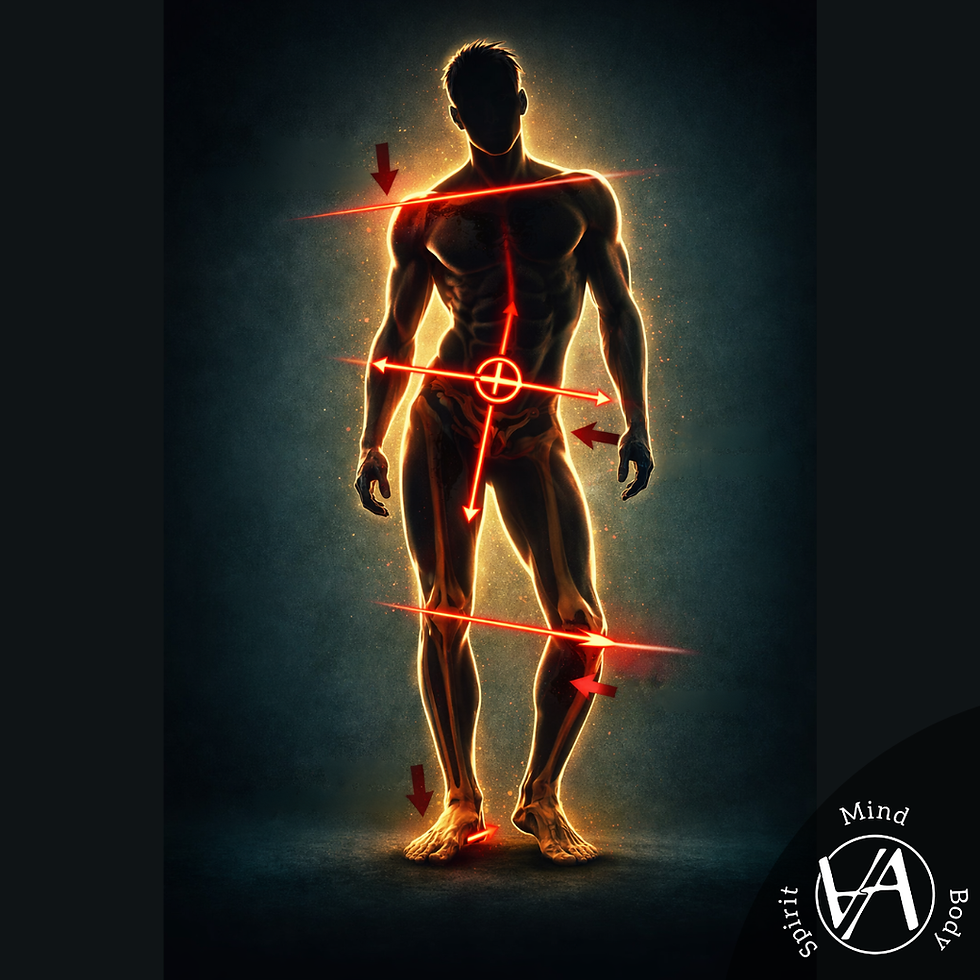
Foot addressed → back responds.
It feels random.
But usually, what happened is:
load redistributed
compensation shifted
a quieter issue became audible
👉 The pain didn’t move randomly.
The body changed strategy.
That’s not regression.That’s information.
So, from a functional point of view, this makes sense.
“MY BODY REACTS BEFORE I EVEN THINK”
This is where people get uncomfortable.
Someone says:
“I felt my watch vibrate — but it didn’t.”
“My arm twitched like I got a notification.”
That’s not imagination.
The body is electrical, chemical, and mechanical.
Nerves communicate in millivolts.
Chemistry creates and transfers charge.
So that muscle contraction has a chemical and electrical origin.
So when something like a smartwatch:
emits signals
interacts with the skin
becomes part of the electrical environment
…the system can become over-engaged.
Not broken.
Just overstimulated.
Once people notice this, they often say:
“Wow… that happens more than I thought.”
Yes.
It does.
We live surrounded by:
signals
alerts
vibrations
constant stimulation (EMF – electromagnetic fields)
And imagine, someone who is constantly tired or overwhelmed, could be affected by EMF.
It could even be energetically as in other people’s energy field. (“that person tires me.”)
Because the system is too activated, too “on”.
That’s functional neurology — not belief.
“I DID EVERYTHING THEY TOLD ME — AND I’M STILL MANAGING”
This is one of the hardest ones.
People follow instructions perfectly:
exercises
stretches
routines
supports
tools
And still say:
“If I stop, everything comes back.”
That’s exhausting.
It usually means the system is being maintained, not reorganized.
Maintenance requires effort, constant attention, discipline.
Reorganization requires accurate input, time, and integration.
If something only works while you actively manage it,
the system hasn’t stabilized yet.
That’s not failure.
It’s a signal.
WHY THIS IS RARELY EXPLAINED THIS WAY
Most approaches are structural.
muscles
joints
tissues
alignment
Very few explain:
how the nervous system adapts
how sensation reorganizes
how compensation shifts
how perception guides movement
why effort becomes chronic
why people feel they must constantly manage themselves
So people are left alone with experiences that don’t match the explanation they were given.
That gap is where doubt appears.
Not because people don’t trust their body —but because no one helped them make sense of what they’re feeling.
What’s missing for most people is the functional layer.
So, this isn’t about fixing a weakness.
It’s about restoring proper functioning.
THE PATTERN BEHIND ALL THESE STORIES
Across all these examples, the pattern is the same:
the body adapted to protect itself
the nervous system reorganized around altered input
compensation became the new normal
over time, that compensation cost energy, comfort, or clarity
That phase can feel:
confusing
subtle
uncomfortable
even disappointing or frustrating at first
The body wasn’t failing.
It was doing its best with incomplete information.
When the information improves,
the system can reorganize.
Not instantly.
Not magically.
Functionally.
IF THIS SOUNDS FAMILIAR
If you’ve ever thought:
“Why did this show up after the surgery?”
“Why did it move?”
“Why do I feel sensations no one warned me about?”
“Why do I have to keep managing myself?”
You’re not alone.
And you’re not imagining things.
Most people live this.
They just don’t get a framework that explains it.
And once you look at it through the lens of function instead of parts,
a lot starts to make sense.


Comments