


How I Practice Kinesiology : It’s Not About Doing More — It’s About How Your Body Organizes Movement

WHEN MOVEMENT IS NOT THE PROBLEM, BUT HOW THE BODY ORGANIZES IT IS
People come to kinesiology for many reasons.
Some want to lose weight.
Some want to gain muscle.
Some want to improve performance.
Some want better habits or structure in their training.
Kinesiology is broad.
It includes all of that.
But there is another reason people end up here.
Something hurts.
Something feels off.
Something doesn’t move the way it should.
Sometimes they were referred by a professional.
Sometimes they already train.
Sometimes they have tried several things and still feel stuck.
So for this article, we’re setting aside:
weight loss,
hypertrophy,
performance and general conditioning.
We’re focusing on something more specific:
what happens when movement becomes painful, limited, or unreliable.
And in that context, most people expect one thing:
a program.
Exercises.
Stretches.
A plan.
Something to follow.
That expectation makes sense.
Kinesiology is widely known as the profession of movement. In Québec, kinesiologists are trained to understand exercise physiology, biomechanics, motor control, physical conditioning, prevention, and rehabilitation through movement. So when someone looks for a kinesiologist, they often expect training, reconditioning, or a structured exercise program.
But the way I practice kinesiology has a more specific focus.
I am not mainly here to give you more exercises to do.
I am here to help your body reorganize how it produces movement.
That is a very different thing.
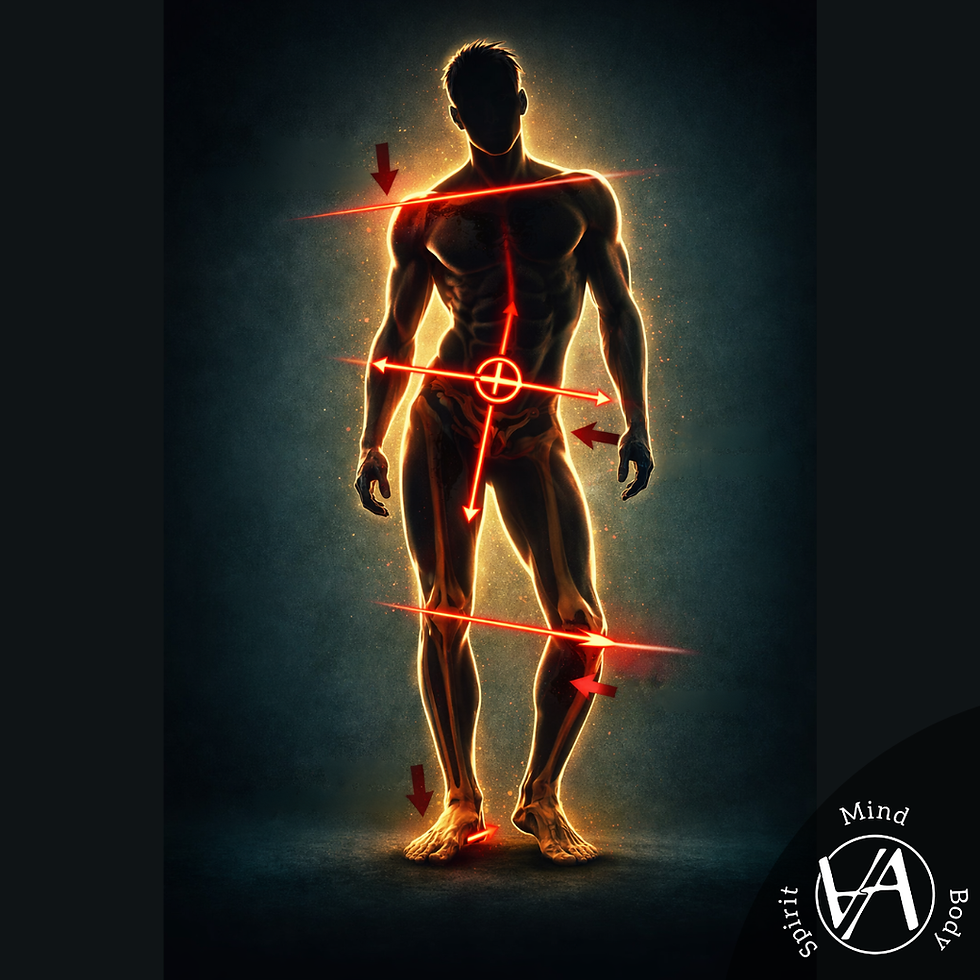
“Pain doesn’t come from a lack of strength or flexibility — it comes from how movement is organized.”
WHEN EFFORT HELPS, BUT THE PROBLEM STILL RETURNS
Many people have lived this:
they do exercises,
they stretch,
they strengthen,
they follow the plan,
and things improve.
That part is real.
Training absolutely changes the body (McArdle, Katch & Katch, 2015).
It can improve strength, endurance, power, coordination, hypertrophy, tolerance to load, and work capacity. Muscles adapt. Connective tissues adapt. The cardiovascular system adapts. You can become more capable, more resilient, and more enduring.
So yes, sometimes training does make things better.
But that does not always mean the underlying organization changed.
Sometimes what improves is your capacity to compensate (Latash, 2012).
Your endurance gets better.
Your tolerance improves.
You can hold the pattern longer.
But when fatigue sets in — often later in the day, at the end of the week, after repeated effort, or when stress accumulates — the same issue reappears.
That is why some people feel “fine” in the morning and worse by midday or evening.
It is not always because the body suddenly failed.
It is often because the output became tired, and the system fell back onto the same compensatory organization it was already using (Enoka & Duchateau, 2008).
This is one of the key differences between training output and reorganizing movement.
“Pain doesn’t need more repetition — it needs a different pattern. Same pattern, same result.”
MOTOR PATTERNS: THE BODY’S MOVEMENT BLUEPRINTS
Every movement you perform follows a motor pattern.
That pattern is like a blueprint.
When you squat, walk, bend, turn, reach, lift, or run, your body is not inventing the movement from scratch each time. It is using an already organized solution.
If that solution is efficient, movement feels smoother, load is distributed better, and effort is used appropriately.
If that solution is less efficient, the body still moves, but it does so by relying more on what it trusts most.
That may look like:
one side working more than the other,
a shift to one side in a squat,
a shoulder taking over,
a hip losing access,
an elbow or knee becoming overloaded,
a movement that “works” but keeps costing too much.
And this matters, because repeating a movement more does not automatically improve the blueprint.
It often reinforces it (Schmidt & Lee, 2011).
“You can’t out-train a pattern that hasn’t reorganized.”
WHY MOVING MORE DOES NOT ALWAYS FIX IT
If the body is already compensating, more repetition often means more repetition of the same strategy.
“Repetition doesn’t fix a pattern that isn’t working.”
That is why someone can train seriously and still notice:
the same tension building up,
the same pain returning,
the same side dominating,
the same plateau.
This is also why some people become very good at “managing” their body without ever truly changing what is underneath.
They become better at coping with the pattern.
Not necessarily at changing it.
WHAT I LOOK AT IN MY KINESIOLOGY
This is where my work becomes more specific than kinesiology as most people imagine it.
I am not mainly looking at whether you need a harder or smarter program.
I am looking at how your body is organizing the movement in the first place.
That includes:
how a movement begins,
where it compensates,
where it overworks,
where it loses access,
how it distributes load,
and how much of the pattern is automatic versus forced.
Sometimes this appears in foundational movements like a squat, hinge, rotation, gait pattern, or reaching pattern.
Sometimes it appears in a very specific movement that matters only to you:
“When I reach here, it hurts.”
“When I turn this way, something catches.”
“When I run, it starts after a few minutes.”
“When I hold weight in my hand, the pain starts.”
Those are not side details.
They are useful entry points.
They show us how your system is solving movement.
THE BODY IS NOT JUST MUSCLES. IT IS A COORDINATED SYSTEM.
Movement is not only muscular.
It is sensory-motor (Shumway-Cook & Woollacott, 2017).
That means movement depends on what your system perceives, how it organizes information, and what it trusts enough to use.
The nervous system is constantly integrating things like:
joint position,
pressure,
timing,
balance,
spatial orientation,
and internal feedback from the body.
That information shapes the motor output (Proske & Gandevia, 2012).
If the information is less clear, or if certain resources are less available, the body does not stop.
It adapts.
That adaptation is intelligent (Stergiou & Decker, 2011).
The objective remains the same: keep moving, keep functioning, keep solving the task.
But the strategy may become costly.
This is where compensation appears.
EARLY ORGANIZATION: WHERE MOVEMENT BEGINS
Some of the patterns we observe later in life are influenced by how the body first learned to organize itself.
This is why early development matters (Adolph & Hoch, 2019).
Early development (0–1 year) plays a role in:
• how we connect to our body
• how we coordinate movement
• how reflexes integrate
• how we stabilize and orient
These early layers influence the baseline your system uses later in life.
A baby does not yet have the movement references of an adult.
It learns them.
Rolling.
Reaching.
Crawling.
Standing.
Walking.
If you have ever watched a baby or toddler learn a new movement, you have seen this directly.
They are not failing.
They are organizing.
They try.
They adjust.
They find resources.
They repeat.
And if a connection is less available, they will still aim for the same result, but with another strategy.
For example, a child may crawl with one side doing more than the other, or organize locomotion in a way that is functional but asymmetrical. The goal is still clear: move, reach, get up, explore. The intelligence is there. But the route may already be compensatory.
That is important because it shows something very simple:
movement organization is not an adult issue.
It is a human issue.
We all started by building movement from experience, trial, repetition, and available resources.
An adult may have far more movement history than a baby, of course. That accumulated experience should give more options. But if the system is still missing access to the right resources, movement can still remain difficult, effortful, or cognitively heavy.
That is why you can coach an adult through a squat, explain it well, give cues, demonstrate it, and still see that person struggle to produce it cleanly.
It is not because they do not understand what you’re saying.
Sometimes the system does not yet have access to the right organization.
WHY I DO NOT START WITH A PROGRAM
A program trains output (Stone, Stone & Sands, 2007).
That matters. Output is real.
It develops:
strength,
endurance,
power,
speed,
hypertrophy,
capacity.
Those are important physical qualities.
But if the body is building those qualities on top of a compensatory pattern, then the system may become more capable without becoming better organized.
If the pattern doesn’t change:
• the same muscles keep overworking
• the same areas keep compensating
• the same issues tend to return
You can get temporary improvement.
But it often requires constant maintenance.
That means the same issue can still come back.
So when I say I do not start by giving a program, it is not because programs are useless.
It is because my first question is different.
Not: “How do we load this more?”
But: “How is the body organizing this, and what is it relying on?”
Because if that changes, the same training can become much more effective (Seidler et al., 2013).
COACHING A MOVEMENT VS GIVING THE BODY BETTER RESOURCES
This is a useful distinction.
You can coach a movement through cues.
You can say:
knees out,
chest up,
hips back,
brace more,
slow down,
push through the floor.
And sometimes that helps.
Bands, tactile feedback, mirrors, verbal cues, and repetition can all improve execution.
But much of that goes through conscious control.
The person is thinking through the movement.
That can improve performance temporarily (Wulf, 2013), but it also means the movement depends on attention and cortical control. (Just like thinking about being straight does not fix posture, read more on that topic here.)
As soon as fatigue sets in, attention drops, or the person stops thinking about it, the old solution tends to come back.
That is different from giving the body back the resources it was missing.
When the underlying organization changes, movement can shift immediately, without needing as much conscious control.
That is not just coaching.
That is reorganization.
REAL-LIFE EXAMPLES
I have seen this many times.
For example, someone with elbow pain (video) and difficulty lifting a load in the hand could suddenly hold and lift much heavier after the system reorganized. The pain was not there anymore, even though the new weight was still objectively above their true strength capacity. They were not suddenly stronger in a bodybuilding sense (Bernstein, 1967). The movement was simply no longer blocked by the same pattern.
Another example: a person on work leave, near the end of a rehabilitation process, still had major functional limitations. Passive range of motion was not the main issue anymore. The real difficulty was how the body used the leg under load.
On a machine, they could barely lift a very small amount repeatedly before needing a break (5lb x 10 reps, 1 set). After working on movement organization and giving the body different resources, their functional capacity changed dramatically within a short period (the day later: 40lb x 15 reps, 3 sets, same exercise). Later, they reported being able to perform movements and work positions they had not been able to tolerate before.
That is the key point:
sometimes the missing piece is not more effort.
It is better organization.
WHO THIS IS FOR
This can help if you are:
someone in pain,
someone active,
someone training,
someone not training at all,
someone referred to kinesiology,
someone trying to return to work,
someone hitting a plateau,
someone dealing with recurring injuries,
someone noticing asymmetry or lack of coordination.
This can include:
tendinopathy,
fasciitis,
bursitis,
muscle strains,
movement-related pain,
recurring overload,
imbalances under load,
sports-related issues,
work-related repetitive strain,
post-injury reconditioning where function still does not feel right.
It can also apply to the person who simply says:
“I don’t know exactly what is wrong, but my body is not moving the way it should.”
And honestly, if you were ever a baby, then you also went through early movement organization like the rest of us.
The question is not whether you learned movement.
It is how your system learned to organize it — and whether it is still relying on strategies that cost too much today.
WHAT CHANGES
The goal is not to force a prettier movement.
It is to help the body reorganize how it produces movement.
When that happens:
movement often feels more natural,
effort becomes more efficient,
the same tension does not build as quickly,
load is distributed differently,
and the body no longer has to rely on the same workarounds.
You are not just getting better at managing your body.
Your body is getting better at organizing itself.
MY KINESIOLOGY IS A DIFFERENT ENTRY POINT
So yes, this is kinesiology.
But it is my way of doing kinesiology.
It is not centered on giving you more to do.
It is centered on helping the system produce better movement with better organization.
From there, training has a stronger base.
Rehabilitation makes more sense.
Performance becomes more sustainable.
And daily life costs less.
IF YOU RECOGNIZE YOURSELF
If you feel like:
“I’m doing all the right things, but something is still off”
then this is often not about doing more.
It is about changing the level you are working at.
Want help from a kinesiologist specialised in movement reprogramming?
Start here 👉 www.andyaudet.com/kinesiologie
Andy Audet – Un Corps Équilibré
Specialist in Body Recalibration and Human Performance
Saint-Bruno-De-Montarville, Québec
References
Adolph, K. E., & Hoch, J. E. (2019). Motor development: Embodied, embedded, enculturated, and enabling. Annual Review of Psychology, 70, 141–164.
Bernstein, N. A. (1967). The coordination and regulation of movements. Pergamon Press.
Enoka, R. M., & Duchateau, J. (2008). Muscle fatigue: What, why and how it influences muscle function. Journal of Physiology, 586(1), 11–23.
Latash, M. L. (2012). The bliss of motor abundance. Experimental Brain Research, 217(1), 1–5.
McArdle, W. D., Katch, F. I., & Katch, V. L. (2015). Exercise physiology: Nutrition, energy, and human performance. Wolters Kluwer.
Proske, U., & Gandevia, S. C. (2012). The proprioceptive senses: Their roles in signaling body shape, body position and movement. Physiological Reviews, 92(4), 1651–1697.
Schmidt, R. A., & Lee, T. D. (2011). Motor control and learning: A behavioral emphasis. Human Kinetics.
Seidler, R. D., et al. (2013). Motor control and aging: Links to age-related brain structural, functional, and biochemical effects. Neuroscience & Biobehavioral Reviews, 37(5), 721–733.
Shumway-Cook, A., & Woollacott, M. H. (2017). Motor control: Translating research into clinical practice. Wolters Kluwer.
Stergiou, N., & Decker, L. M. (2011). Human movement variability, nonlinear dynamics, and pathology: Is there a connection? Human Movement Science, 30(5), 869–888.
Stone, M. H., Stone, M., & Sands, W. A. (2007). Principles and practice of resistance training. Human Kinetics.
Wulf, G. (2013). Attentional focus and motor learning: A review of 15 years. International Review of Sport and Exercise Psychology, 6(1), 77–104.


Comments