


What’s the Best Exercise to Fix Posture?

WHAT MOST PEOPLE EXPECT
If you ask five professionals how to fix posture, you’ll get five different answers.
Some will say:
• Rows
• Face pulls
• Deadlifts
• Core strengthening
• functional training
• Stretch your chest
• Strengthen your back
• Yoga
And to be fair — those can help.
Sometimes your posture even looks better afterward.
But here’s the real question:
If one exercise could fix posture…
why are so many people still working on it years later?
THE FIRST LEVEL: MUSCLES
Most posture advice lives at the muscle level.
“Tight hip flexors.”
“Weak glutes.”
“Rounded shoulders.”
“Upper cross syndrome.”
The idea is simple:
Identify the weak muscle.
Strengthen it.
Stretch the tight one.
Problem solved.
But muscles don’t create posture.
They respond to it.
They are not the decision-makers.
They are the employees.
If one muscle looks overworked, it’s usually because the system assigned it too much responsibility.
Fixing the employee doesn’t change the business model (in this case the postural strategy).
THE SECOND LEVEL: ORGANIZATION
Before you “stand up straight”…
Before you pull your shoulders back…
Before you brace your core…
Your nervous system already decided:
• where your center of gravity sits
• how much tone to create
• how to distribute load
• how to stabilize in relation to gravity
That happens automatically.
Posture is not a position you hold.
It’s an organization your system runs.
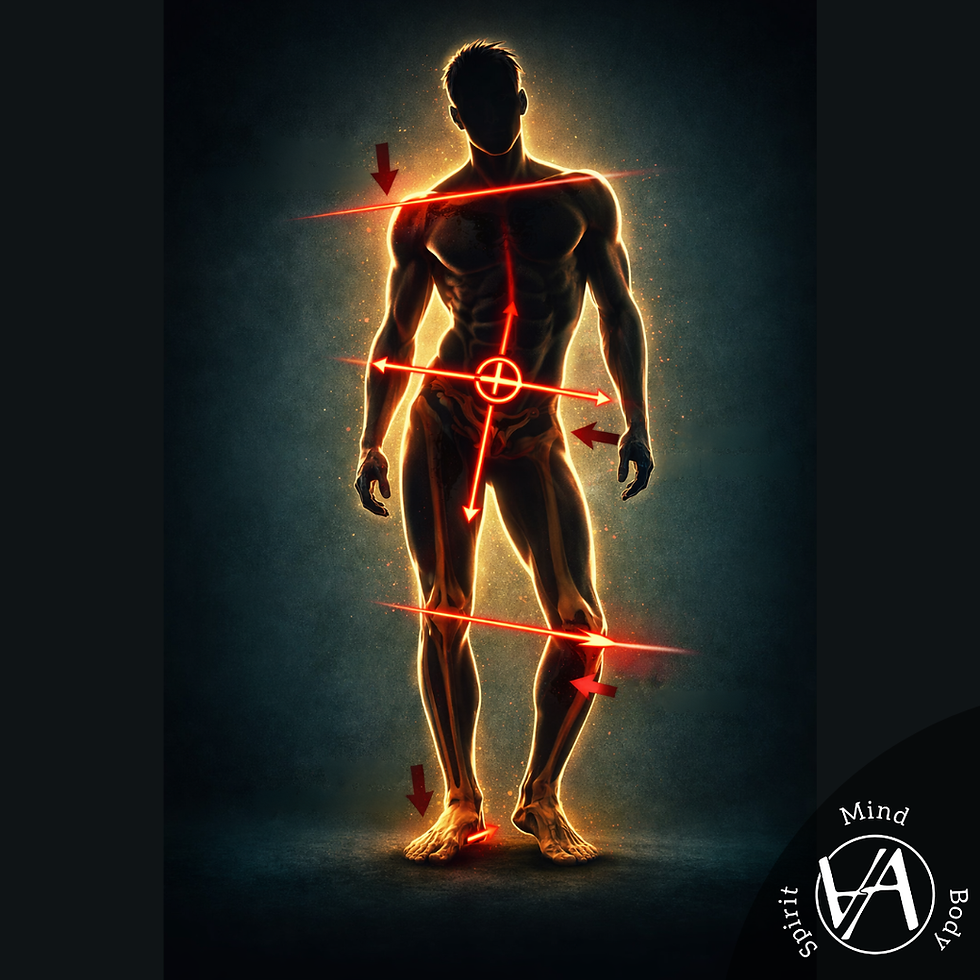
If your system has inadequately organized its balance strategy in a certain way, it may show up as:
• forward head posture
• rounded shoulders
• anterior pelvic tilt
• pelvic shift
• more weight in one hip
• increased lordosis
• increased kyphosis
These are visible outcomes.
They are not the root decision.
They reflect how your nervous system is currently orienting in space and distributing load relative to gravity.
No single exercise overrides that.
Because you’re looking at the result of the strategy — not the strategy itself.
Thus, the pattern isn’t local.
It’s systemic.
WHY EXERCISES SOMETIMES WORK (BUT DON’T LAST)
You strengthen your upper back.
You stretch your chest.
You do the routine consistently.
It improves.
For a while.
Then you stop doing it.
And it comes back.
Because you trained a muscle.
You didn’t update the reference your brain uses to organize posture.
The exercise created temporary capacity.
Nothing about the internal map changed.
But the underlying strategy didn’t change.
You were manually overriding it.
So, when the extra effort disappears, your system returns to its default organization.
That’s not the same as reorganizing it.
“BUT I CAN JUST THINK ABOUT MY POSTURE”
A lot of people try this.
They stand against a wall.
They self-correct.
They consciously pull themselves upright.
They walk around trying to “hold good posture.”
That works through attention.
Through effort.
Through the prefrontal cortex — conscious control.
But posture is not meant to be managed by thought.
It’s meant to run automatically.
If you have to think about it constantly, it isn’t integrated.
You’re layering effort on top of the same underlying reference.
Nothing deeper changed.
Because posture isn’t driven by muscles or by thought.
It’s driven by how your nervous system orients your body in space.
Your brain constantly integrates information from your eyes, inner ear, feet, and proprioception to determine:
• where vertical is
• where your weight is
• how stable you are
That orientation process runs automatically — and posture reflects it.
ISN’T BALANCE TRAINING THE ANSWER THEN?
This is where people go next.
“If posture is about organization, I’ll just do balance drills.”
Single-leg stance.
Bosu balls.
Stability challenges.
But random stimulation isn’t recalibration.
Balance drills stimulate the system.
They don’t necessarily update the specific reference your system is using.
And here’s the part most programs miss:
What needs updating is specific to you.
Your system’s reference is not the same as someone else’s.
Which means posture is not a downloadable program.
It’s not a universal routine.
It’s not a generic protocol.
It depends on how your system is organizing you.
VISUALLY STRAIGHT VS NEUROLOGICALLY ORGANIZED
You can look straight.
You can stand tall.
You can take a perfect “before and after” picture.
That doesn’t mean your nervous system reorganized.
Visual symmetry does not automatically equal efficient organization.
You can manually align yourself.
But if the underlying reference doesn’t change, your system will return to its default strategy the moment attention drops. (That’s also often when people wonder why a certain pain came out of nowhere.)
That’s why people say:
“I can fix it when I think about it.”
But it never becomes effortless.
THE BETTER QUESTION
Instead of asking:
“What exercise fixes posture?”
Ask:
“Why is my system organizing me this way?”
That question changes everything.
Because now we’re not chasing muscles.
We’re looking at the level where posture is decided.
SO WHAT ACTUALLY CHANGES POSTURE?
Not forcing.
Not bracing.
Not constant correction.
Not aggressive strengthening.
Posture changes when the reference your nervous system uses to orient in space becomes clearer.
Not by training muscle.
When your system has a more accurate sense of:
• vertical
• weight distribution
• joint position
• balance
It reorganizes.
Automatically.
Without you holding it.
Without rehearsing it.
Without thinking about it.
THE SHIFT
Muscle-focused posture work is simple.
That’s why it became trendy.
It’s easy to sell a program.
“Do this routine for 30 days.”
But posture isn’t a 30-day muscle challenge.
It’s a system-level organization process.
And the good news?
Working at the system level isn’t harder.
It’s often simpler.
Because you’re not fighting the body.
You’re updating the reference it uses.
When the reference updates, the organization follows.
SO WHAT ACTUALLY WORKS AT THAT LEVEL?
If posture is organized by your nervous system’s reference to where you are in space,
then the solution isn’t strengthening harder.
It’s refining the reference.
That’s where Posturology comes in.
Posturology doesn’t start by chasing weak muscles.
It looks at how your system is organizing itself in space.
It refines the sensory references your nervous system uses to decide:
• where vertical is
• how weight is distributed
• how stability is created
• how movement is initiated
When those references update, muscles redistribute effort on their own.
The overworked employee finally gets help.
And posture stops being something you have to “hold.”
Bonus, this requires minimal effort.
Sometimes one to three very specific inputs — tailored to your system — practiced for a minute each, can progressively reorganize posture.
Not by forcing it.
By updating it.
If you want to understand how that applies to you,
you can explore Posturology here →
There isn’t one best exercise to fix posture.
There is a better level to address.
And when you address it, posture becomes the result — not the goal.
Want to know what your systems constantly asks itself to be able to organize properly in space? Read here →
Andy Audet
Specialist in Body Recalibration and Human Performance
Saint-Bruno-De-Montarville, Québec


Comments