


Here Are 3 Reasons Your Pain Keeps Coming Back – (Even After Treatment, Rehab, or Strength Training)
Updated: Mar 17

You rest.
You strengthen.
You stretch.
You get therapy.
It improves.
And then — months or years later — it’s back.
Not necessarily worse.Not necessarily constant.But recurring.
This doesn’t mean your body is broken.
It usually means the source of organization — the system that coordinates posture and movement — never truly updated.
In other words:
The downstream symptoms changed.
The upstream control system didn’t.
By “upstream,” I mean the neurological and sensory processes that organize your posture, balance, coordination, and muscle recruitment before movement even happens.
Here are three reasons recurring pain follows that pattern.
1️⃣ THE MAP WAS NEVER RECALIBRATED
(Chronic pain isn’t only about tissue damage.)
Modern pain science shows that tissues often heal faster than pain resolves (Moseley & Butler, 2015).
Why?
Because pain is not just about tissue —
it’s about how the nervous system organizes movement.
When I say “map,” I mean the brain’s internal model built from:
visual input (eyes)
foot pressure and ground reaction
vestibular orientation (inner ear balance)
joint position sense (proprioception)
movement sequencing hierarchy
Your brain builds posture and motor control from those inputs.
If that reference is distorted,the body organizes around it.
Rehabilitation, strengthening programs, mobility work, and therapeutic interventions can:
reduce pain
increase mobility
build strength
But if the sensory reference underneath doesn’t recalibrate,
the organization remains compensatory.
The tissue healed.
The strategy didn’t.
Under fatigue, stress, or repetition —
the body defaults to its old pattern.
Not because treatment failed.
Because the blueprint never changed.
2️⃣ YOU BUILT STRENGTH INSIDE A CONDITIONAL WINDOW
(Relief doesn’t always equal integration.)
Many people with recurring back pain, hip pain, or knee pain develop rituals before training.
They:
mobilize
foam roll
stretch
activate glutes
“turn on” the core
And it works.
They feel looser. Stronger. More stable.
But here’s the real test:
If you skip the ritual — does the improvement hold?
If not, the baseline never changed.
You didn’t gain integrated capacity.
You gained temporary access.
This is especially clear with muscle activation.
“If a muscle isn’t being recruited automatically during real movement, isolated exercises alone may not integrate it into the pattern.”
You can pre-fatigue it.
You can feel it burn.
You can create awareness.
But sensation is not integration.
Integration means:
You don’t have to think about it.
The system recruits it automatically.
That difference explains why many rehab programs reduce pain short-term — but symptoms return when the ritual stops.
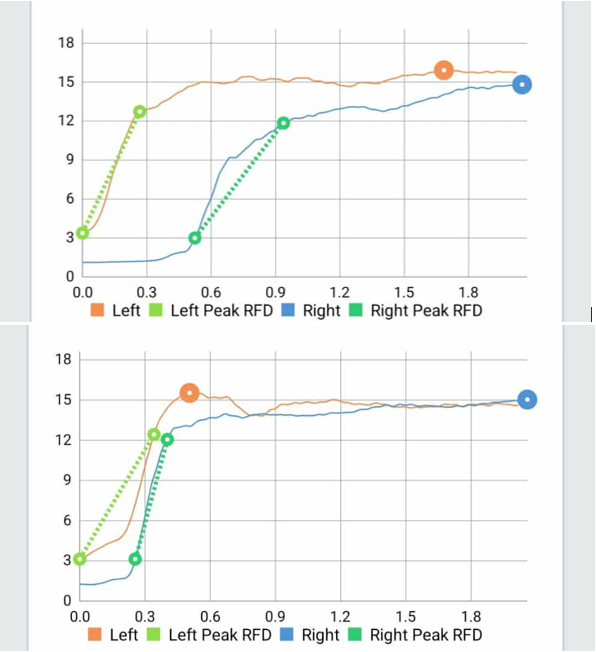
(Here is a video that demonstrates that the asymmetries remain even after a full training. The Q-Technologie was used here to optimise the nervous system.)
3️⃣ COMPENSATION CONSUMES BANDWIDTH
(Why recurring pain and injuries worsen under fatigue or stress.)
When posture and motor control are unstable,
the brain compensates.
Often through:
increased conscious control
higher muscle tone
co-contraction
prefrontal supervision (the part of the brain responsible for deliberate, effortful control)
That works — temporarily.
But compensation consumes bandwidth.
Bandwidth is your nervous system’s available capacity to organize movement efficiently and automatically.
You can think of it like a battery.
Every compensatory contraction, every layer of protective tension, every moment of conscious override pulls energy from that battery.
This is why many people notice their back pain, neck pain, or hip pain increases at the end of the day.
Not after years.
After hours.
I’ve had clients say:“8:00 a.m. I’m fine.
By 8:05, I’m already tight.”
By mid-day, symptoms increase.
By evening, everything feels heavier.
That’s not random.
It’s accumulated compensation draining available bandwidth.
Each cycle of override:
accumulates residual tension
reinforces protective movement patterns
reduces variability
increases energy cost
Over time:
Two years of relief becomes one.
One year becomes six months.
Six months becomes constant flare-ups.
Because the more compensation you stack,
the less reserve you have.
Under fatigue, stress, or repetition —
the system defaults to its dominant hierarchy.
If that hierarchy was never recalibrated,
recurrence is predictable.
This isn’t weakness.
It’s accumulated compensation exhausting the system.
WHAT ACTUALLY CHANGES WHEN IT’S INTEGRATED?
When postural reference recalibrates, change is immediate and observable.
Not just “less pain.”
But measurable shifts such as:
Weak muscles test strong instantly
Trunk rotation improves without stretching
Stabilization improves when externally challenged
Global muscle tone decreases
Movement feels effortless instead of supervised
Output increases while effort drops
Nervous system tone becomes calmer
This aligns with research on sensorimotor integration and postural control (Peterka, 2002; Proske & Gandevia, 2012).
The difference is simple:
The window stays open.
No ritual required.
No activation sequence needed.
No constant correction.
Just access.
DOWNSTREAM VS UPSTREAM IN CHRONIC PAIN
Most conventional approaches to chronic pain work downstream:
treat tissue
reduce inflammation
strengthen muscle
stretch tight areas
improve range of motion
All of which can be helpful.
But if the upstream sensory reference and movement hierarchy remain unstable,
the body reorganizes around the same distortion.
Posturology works upstream.
Not by forcing muscles —
but by refining the sensory inputs that the brain uses to organize posture, balance, and movement.
When reference stabilizes:
Load distribution changes.
Muscle recruitment improves.
Energy cost drops.
Compensation decreases.
Recurrence slows — or stops.
THE BOTTOM LINE
Recurring pain is rarely about lack of effort.
It’s usually about organization.
You can:
strengthen compensation
stretch compensation
manually release compensation
Or you can recalibrate the system that generates it.
One consumes bandwidth.
The other restores it.
Andy Audet
Specialist in Body Recalibration and Human Performance
Saint-Bruno-De-Montarville, Québec
References
Moseley, G. L., & Butler, D. S. (2015). Fifteen years of explaining pain. The Journal of Pain.
Peterka, R. J. (2002). Sensorimotor integration in human postural control. Journal of Neurophysiology.
Proske, U., & Gandevia, S. C. (2012). The proprioceptive senses: Their roles in signaling body shape, body position and movement. Physiological Reviews.


Comments