


When Curiosity Replaces Frustration, the System Can Finally Change

One of the things people often leave with isn’t just less pain.
It’s curiosity.
Curiosity about their body.
Curiosity about how things connect.
Curiosity instead of frustration.
That shift may seem subtle, but it’s often the most important one — especially for people who feel stuck, who have tried many things, and who sense they’ve reached a dead end.
Because frustration narrows perception.
Curiosity opens space.
And space is essential when the body has been compensating for a long time.
PAIN IS RARELY JUST LOCAL
Many people arrive focused on a specific area:
the foot, the knee, the hip, the back.
But over time, they begin to sense something different:
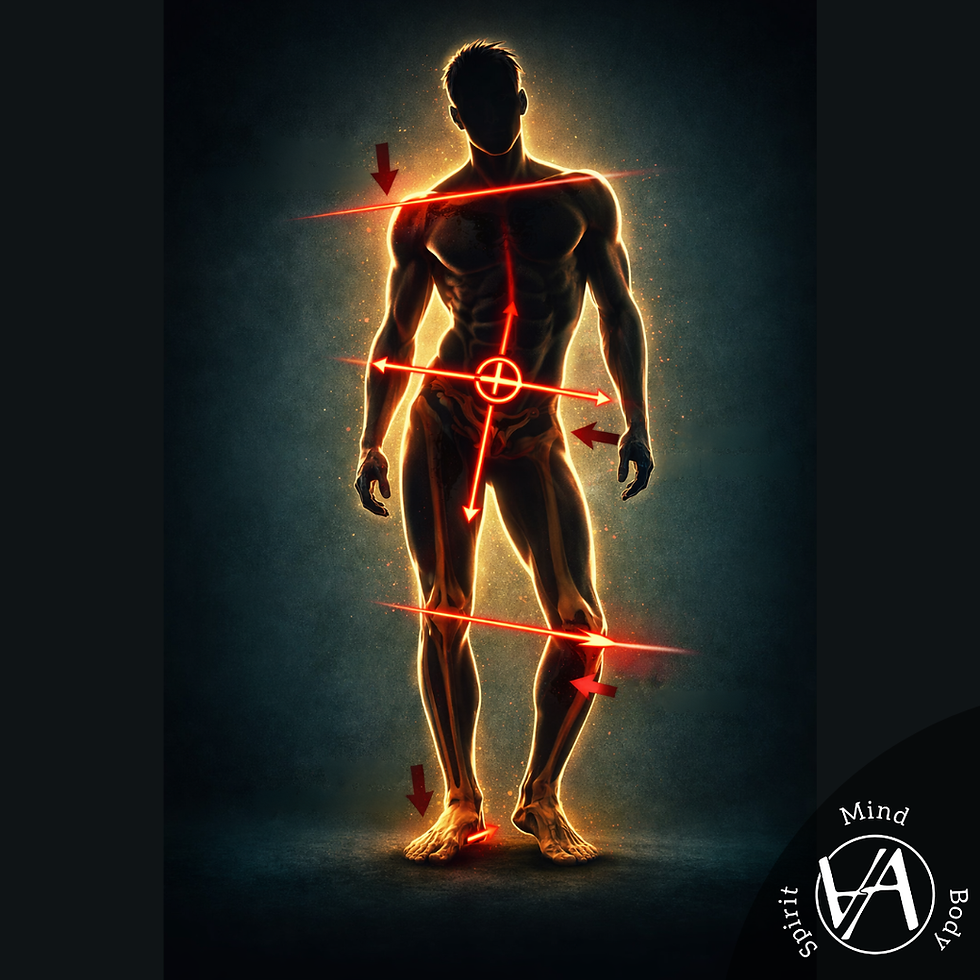
that pain isn’t only about where it shows up, but how the system is organizing itself.
Pain often reflects a larger organizational pattern.
Not a failure.
Not weakness.
Not a lack of strength or flexibility.
But a system that has been managing load with limited options.
WHEN STRENGTH AND FLEXIBILITY AREN’T ENOUGH
A common realization is this:strength and flexibility alone don’t always resolve underlying dysfunctions.
People can be strong.
They can be mobile.
They can be disciplined with exercises.
And still feel that something isn’t right.
Why?
Because movement isn’t just mechanical.
It’s sensory.
The body depends on clear feedback to organize itself efficiently.
When that feedback is fuzzy, confidence drops — and compensations rise.
The system starts choosing tension as a strategy.
As one pattern often reveals itself:
Stability is being purchased with tension.
LOAD REVEALS WHAT REST HIDES
Many issues don’t show up at rest.
They appear with:
repetition
weight bearing
time
Long days at work.
Prolonged standing.
Long walks.
Training sessions that seem fine at first… then slowly degrade.
People often sense some version of:
“My system can cope for a while — but then it runs out of clean options.”
That’s a classic load-dependent pattern.
It doesn’t mean the body is fragile.
It means there’s an asymmetry in how load is being managed.
The system adapts — until adaptation becomes expensive.
WHY ORTHOTICS SOMETIMES HELP… THEN STOP HELPING
This is also where orthotics often come into the picture.
They can help temporarily.
Not because they restore function — but because they replace sensation.
They give the system something stable to organize around.
But replacement isn’t restoration.
If the underlying sensory information isn’t clarified, the system remains dependent.
Remove the support — or increase the demand — and compensations return.
Again, not failure.Just incomplete information.
FROM “DOING MORE” TO LISTENING DIFFERENTLY
One of the deeper shifts people experience is moving away from:
“what else should I do?”
Toward:“what is my body perceiving — or missing?”
This doesn’t mean passivity.
It means accuracy.
Listening here doesn’t mean interpreting symptoms or overanalyzing sensations.
It means restoring access to clear sensory input so the body can reorganize itself.
When that happens, new options appear — without forcing them.
WHY CURIOSITY CHANGES EVERYTHING
Curiosity changes the entire problem-solving landscape.
It replaces self-blame with observation.
It replaces urgency with orientation.
It creates room for the system to update itself.
And that’s often when things finally begin to move.
Not because someone tried harder.
But because the body had enough space — and enough information — to choose differently.
When perception changes, problem-solving changes too.
And sometimes, that’s the doorway everything was waiting for.
A SIMPLE WAY TO START NOTICING DIFFERENTLY
For some people, this shift toward curiosity begins naturally after a session.
For others, it starts earlier — simply by learning how to notice their body differently in daily life.
That’s why I created 5 Days of Awareness.
It’s not an exercise program.
It’s not about fixing anything.
It’s a short, guided way to bring attention back to the most basic layers of how your body organizes itself — breath, orientation, balance, and movement — without effort or correction.
Many people use it as a first step when something feels “off” but hard to define.
Others use it to prepare their system before going deeper.
And for some, it makes clear when the body is ready for a more precise, in-person assessment.
That’s where posturology comes in.
Posturology is the place where we look at how your system actually manages position, load, and sensory information — not just where it hurts, but how it organizes itself underneath.
It gives the body clearer input so it can stop compensating and start reorganizing.
There’s no obligation and no sequence you have to follow.Just different doorways, depending on where your system is right now.
If curiosity is present, that’s usually enough to begin.

Comments